Amazon
Last Update
/
5
Min
Heading Out to Amazon
Here I am, Brazil!
The crystal and twinkling early morning sun was shining on my face. The cold and refresh air in the winter completely woke me up. I put on my sunglasses. The excitement of travel started to rise. Especially the trip to Amazon, the place I had applied four visas for. :-)
I crossed my fingers, hoping everything will be fine. For something you have tried so many times, when it comes to true, you would be nervous and wouldn’t believe it’s true. I didn’t have time to get the yellow fever shot. Happy and safe travel!
The young couple at the airport checked in everything but forgot to put their two years old son on the list! LOL!
While waiting for my flight, I was wandering around the news stand. Jennifer Aniston, the oldest unmarried woman, got pregnant with twins, a girl and a boy. :-)
Two hours later, I arrived in Miami. The airport changed to tropical scene: tequila, palm trees, bamboo lamps, etc. "Sí" is everywhere in the air.
Airport food was horrible. It felt that I was cooking my own lunch with salt, pepper, ketchup and spicy sauce, everything I could find on the table to make my meal tastier. Johnny Monis never leaves salt and pepper on the table in his restaurant. In his opinion, if the customer needed to add salt or pepper to his or her meal, the chef failed.
I sat next to the window and tried to enjoy the half self-cooked lunch. Outside the glass, it’s a busy holiday scene: the little blue carts running around shuttling luggage, crying baby and dismayed passengers, like Philip. :-)
I like this: sitting in a quiet corner, watching the busy crowd, writing and thinking, just taking a pause in life.
I was quite surprised when I saw there were four direct flights from Miami to Cuba on the blue monitor. I thought US still imposes embargo on Cuba. Now I felt Cuba is really not that far away.
What are my next destinations? India, Cuba, Southeast Asia, Africa, Egypt, Israel…
I’m spending a full day traveling between airports just to get to another city...
I just flew over equator. Was it the first time I'm in south hemisphere? No. I’ve been to Peru before. This was the second time.
Finally, around middle night, I arrived in Manaus. As I walked out of the airplane, I could immediately feel the humidity in the air. There must have been too much rain. A couple of plastic baskets were put on the floor to collect the water leaking from the roof.
The van from the tour company, Gero, picked me up from the airport and dropped me at the hotel next door. While we were waiting for other people in the group, I met some very cool travelers: an Indonesian guy who studied in US and now works in Brazil and his friend a lovely and talkative German girl.
I really enjoyed this life style: travel to new places and meet new people.
A Long Journey
I didn't set up the time zone correctly last night and the alarm sounded one hour early in the morning. Perfect timing to wander around Manaus downtown. Manaus is a poor little town — a very small downtown, heavy with Portuguese influence. Every time I come to a place like this, it feels like time has turned back to the China I remember from my childhood, where the streets were dirt and the buildings were worn-out but people's hearts were purer.
The Opera House appeared to be splendid in this small town: the pink walls and the shining green dome — like a heavily made-up new bride. The church across the road looked like a weathered old man who had seen it all. Because it was Christmas Eve, there was an event at the church: a full house of people, and at the front an elderly man in white ceremonial robes, chanting and reciting. Coming out of the church, on the other side of the road was a square. There was a column in the center, the victory figure at the top so lifelike. Each side of the column has sculpture on it: Africa, Asia, Europe and America. Exploring and discovering new land was the glory dream of Portugal when the limitations of transportation and communication still left big blank spaces on the map.
At around 9am in the morning, I started my transfer from Manaus to Dolphin Lodge in the jungle. After thirty minutes bus ride, we arrived at the Ceasa port, “Ceasa to Careiro”, a crowded port to transfer people, goods and even cars and trucks across the mighty Amazon River. Finally I saw the Amazon River!
It took the speed boat about twenty minutes to cross the river. The wide water looks like ocean. The waves were quite strong, causing the boat bounce up and down. When we reached the meeting of the river, the captain turned off the enginner so we can have a close look at this famous tourist spot. The yellow, muddy, fast and cold Rio Solimões and the black, clear, slow and warm Rio Negro meet each other and run side by side for another 6 km without mixing. I can clearly see the distinctive colors of the two streams. Putting my hand in the water, I can feel the difference of the temperature.
Twenty minutes later, we arrived at the other bank of the Amazon River: Careiro village. It's a cute village built right on the bank of the river. Fish market, fruit stands and little grocery stores were right on the boardwalk. A few long wooden planks connected a path along the muddy riverbank. Walking up a dozen wooden-plank steps brought you to the houses where the locals lived. The entire village was built on stilts. Threading through the narrow wooden-plank walkways between houses brought you to where the tour company's van picked up and dropped off passengers. The rainy season had just begun, and the red mud on the ground was already deeply rutted with tire tracks. In just a few steps my shoes were thick and heavy with mud.
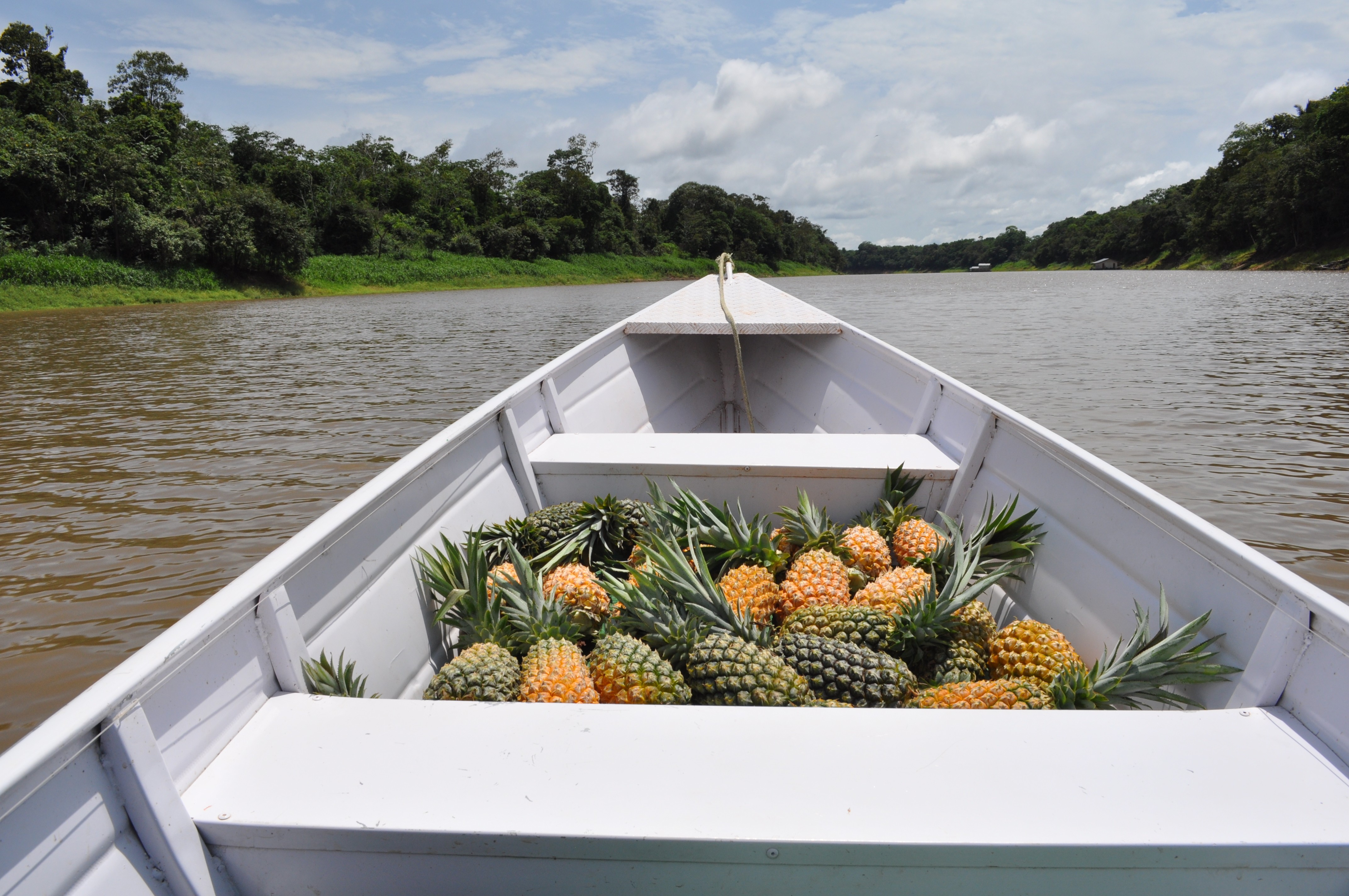
We boarded the van and the third leg of the journey began. Along the road you could see local people still living in a very primitive way: clothes hanging outside to air dry, unpaved muddy roads, and houses built on stilts so they wouldn't flood in either the dry or rainy season. After another hour of jolting, we reached the Parana do Mamori River. Paradise began here. For half an hour, the motor canoe glided through a green corridor. Both banks were lush tropical rainforest — large-leafed palms, dense shrubs, long curving vines. Birds perched at the treetops along the river. Grey and pink dolphins rolled in the water. Caimans sunbathed with wide-open eyes. Occasionally a few local houses appeared, some built on the bank, some floating on the water. In the Amazon, water rules everything.
Finally, the boatman pointed to a few buildings on a hillside not far away: 'That's Dolphin Lodge.' The name could not have been more fitting. Dolphins travel in the river in front of the lodge: pink or grey. Pink ones were louder, making noises like dogs barking. The grey ones were more elegant, like old men. The lobby had a truly breathtaking view. Outside the window, a great river wound its way past. Walking down two dozen steps brought you to the dock where several canoes and boats were moored. The place was small and very quiet. There was only a German couple staying when I arrived. I fell in love with this little place immediately.
Welcome drink, lunch, chatting etc. In the afternoon, the guide took us out for fishing. First time in my life, I caught a fish and it’s a little piranha! Because it’s still a baby, I had to let him go. I learned from this trip that piranha is actually not that aggressive. Only in rare conditions they attack humans but some species do eat other fish’s fins!
The first day in the Amazon, we were caught by heavy rain. Luckily, there was a covered boat moored at the bank. We took shelter inside it.
The Amazon at night is a symphony performed by insects, frogs, and countless unnamed jungle residents. The night was not quiet at all — a thousand different timbres, rising and falling, high and low.
Today was Christmas Eve. Mao was cutting palm tree leaves to decorate the dinner table. Mao is a hardworking, diligent Amazonian.
We waited so long for dinner that we were starving. But what came was a lavish Christmas feast. The turkey was delicious — crispy skin and juicy meat. The turkeys here are also a size smaller than those in North America. In the Amazon I tasted real tropical fruits. Picked only when fully ripe on the tree, truly organic, with rich and intense flavor. Though much smaller than what we buy in North American supermarkets, they were bursting with fruit flavor. By comparison, supermarket fruit tastes like chewing cotton candy. Mao's family and friends joined us.
Whether I had grown used to it or whether the insects had tired as night deepened, it seemed to quiet down around me. The Amazon night has no neon lights, no human clamor, no familiar cars passing or horns sounding. Only the calls of insects, and the occasional sound of a boat motor passing. The world can be so different!
Go to different places, experience different lives.
Christmas Day
We did the jungle walk, the classic Amazon activity, in the morning. The trip was like a fairy tale come true. The big leaves of the tropical plants blocked the sun. Trees, shrubs and vines grew densely together. The plants, saturated with moisture and oxygen, were a vivid, dripping green. The flowers were mostly extravagantly vivid. Groups of monkeys swung through the treetops. Brilliantly colored birds called at every level, high and low, without pause. Termites and leaf-cutter ants were busy transporting food or building their homes. And all kinds of unnamed creatures dug holes in the ground and built nests in the trees. The dense jungle was a busy world utterly unfamiliar to me.
We saw three groups of monkeys jumping over the top of trees. They are squirrel monkeys and brown howler monkeys. The monkeys in the Amazon rainforest are small, like cats.
As we walked deep in the all-encompassing green of the jungle, a postcard-sized blue butterfly drifted into my field of vision like something from a fairy tale. Its blue wings gleamed and shimmered.
The guide stopped and pointed to a hole in the ground: 'This is Pata's home.' As he spoke, he stomped his foot on the ground twice. Suddenly, an animal resembling a small pig shot out of the hole and ran heavily past our feet. It gave everyone quite a fright.
The price of living a fairy tale was being bitten by all manner of insects and wasps. The German girl was bitten by a wasp. 'It hurts like hell.' Without realizing it, we walked through the flying ants' territory and trespassed on their domain. Mao and I were in front; I was only stung once, like a needle prick. The German couple walking behind paid the price — the bites had the refined European girl swearing the 'f' word.
I love the jungle. A completely unfamiliar, strange and dangerous world. It can surprise you at any moment.
This afternoon our luck wasn't good. Couldn't see the pigs, couldn't spot the dolphins either.
This is a real vacation: staying at the lodge, eating when hungry, playing when awake.
Dinner was great: vegetable and beef soup, fish, banana pudding as dessert and, FRUIT! I eat much better when I'm not at home. :-)
I took my first full shower in cold water. The water was from the river. I was told it was filtered, but it’s still yellow.
After dinner, Mao took us caiman spotting. We had a blast, full of surprises. The moon was nearly full, blazing brightly in the endless sky. Moonlight poured across the surface of the river — Li Bai would certainly have composed a poem here.
We boarded a small wooden boat — all six of us — and began the night tour. The Amazon rainforest at night was calm yet full of life. 80% of insects are active at night. Mao turned on his head lights. In the bright white light, we saw a few pairs of red eyes mysteriously turning left and right in the dark. It's caiman! Mao asked his assistant to turn off the motor. Suddenly, complete silence fell over the river. Mao bent down, lying flat at the bow, extending his right arm. When the boat got close enough, he lunged forward and seized the caiman by the neck. He got it!
The caiman pretended dead in Mao's hand, eyes closed and limbs loosed. We were so excited. We touched it, played with it and took photos of it. When we had enough fun, Mao let him go. The moment Mao put it back in water, the “dead” body regained the energy and ran away quickly.
We saw another bigger one. Mao tried to hit him with the paddle. It jumped away, splashing the way half a meter high. I was scared to death.
Quietly, our canoe glided into the narrow channel. The Amazon forest under cover of night was a completely different world, a world belonging to completely different groups — frogs, insects, birds and thousands of other animals whose names I don't know.
The owl was singing in the dark.
What a night!
Camping in the Jungle
We woke up really early for a jungle walk, expecting to see some birds or animals, but didn't see too much. Maybe it’s because we were all half awake and half asleep.
After breakfast, Mao took us to see the banana and rubber plantation. Mao's long story about plantation, colony, exploitation and slaves, a story which has been told many times, bored me a little bit.
Following Mao, we walked in the forest with no trails and marks. Mao, with a big machete in his hand, looked like a frontier solder, cutting branches and leaves making a trail out of nowhere.
Local people still live in a poor condition. We walked by Mao's friend and brother's houses. Most of the houses were built by wood with palm tree leaves roofs. A little red clay house stood out easily out of these dark brown wooden houses. Mao told me this clay house was great because it's cool inside, a luxury in the hot and humid rain forest. Amazonian are way behind modern civilization.
After an entire morning of jungle walking, my clothes were soaked through. We didn't see too many new things.
The German couple was leaving tomorrow. The rest of us were debating whether to camp in the jungle. Everyone felt it was a once-in-a-lifetime opportunity, but everyone was also a little afraid. After going back and forth several times, we decided — tonight we will sleep in the jungle!
Mao said nothing and simply began preparing the camping equipment. After lunch, we set off.
One small boat, with Mao and his assistant — eight people in all. We traveled through channels, lakes, creeks and more. Both banks were an unbroken wall of lush green forest. The locals all built their houses on slightly higher ground. This is truly the Amazon experience. I couldn't tell whether the water surrounded the land, or the land surrounded the water. About an hour later, Mao stopped the motor. We paddled a little bit more and finally reached a quiet place in the forest.
After Mao unloaded all the supplies, he sent us to go fishing with his assistant. Dark water doesn’t have too much fish. It’s not as easy as the other day, when we fished in the muddy brown water. I had to be very patient. Not a bad afternoon, I caught three baby piranhas in total, tying at the top with the German guy. The third one came right after the second. What a lucky day! But all of our catches were thrown back to the water because they were too small to keep.
Fishing is something new I learned during this trip and it was fun. This is something I probably have experienced in life but never as a sport. I know I’m not really good at it…All you can do is to prepare everything and patiently wait: put the bite in the hook in the right way so the fish won't easily take the meat and run, pick up the right part of the water, most of the time, the fish swims in the water where there are lots of grasses, stirred the water to make the sounds of falling nuts to attract the fish, throw the fishing line out, and wait, wait and wait. When luck comes, no hesitation, pull the line immediately. You may get the fish or lose the bite. No guarantee for fish every time, but in the long run statistics would work.
Being all beginners, we quickly used up all our bait. Nothing to do but head back. The scenery on the way was beautiful: crisp reflections of clouds in the water, rippling water grass swaying wave after wave in the breeze, lush trees on the banks, and the occasional exotic bird skimming the water's surface or darting past the treetops.
Back at the campsite, Mao had already hung the hammocks in a slightly flatter spot surrounded by several large trees. Unlucky — right after we returned to the camping site, it started raining. It seemed every time we fished, it rained. Mao put up the plastic cover, but it was not big enough. Mao had to take down three hammocks from the trees. Eight of us sat under the cover, waiting for the rain to stop. Everyone was praying it wouldn't be a wet night.
Finally, the rain stopped. Mao and his assistant started cooking. His assistant is such a nice guy. He doesn’t speak English. His smile communicates the kindness and generosity in his heart.
Mao proved himself a true Amazonian. He knew exactly how to use the resources the forest provides to survive. He found several Y-shaped sticks to set up a grill, gathered a pile of branches for firewood, and placed the chicken over it. He then cut a few palm leaves and spread them on the ground as a table. Mao is not only a good guide but also a good cook. The roasted chicken came out crispy-skinned and fragrant, with the scent of smoke. And so — a plate of smoked chicken, some rice and some local seasoning powder — eight of us sat on the ground and ate a simple but delicious dinner.
After dinner, everyone sat in a circle and talked. I love this kind of group — people from all over the world, sharing experiences and speaking their minds.
The moon was beautiful — hiding behind clouds one moment and breaking through the next. Around us was a world completely unfamiliar to me — dense forest, water, and a thousand kinds of calls. I felt excited and curious, with a touch of fear. Marcel from Switzerland had signed up for a ten-day jungle survival program. I'm not sure if I could spend ten nights in the jungle with only the guide and myself.
After dinner, everyone got in the hammock and tried to sleep. Sleeping in the jungle turned out to be a very brave decision. What had sounded like a novel, romantic idea turned terrifying when everyone stopped talking and the sounds of nature rose up from all directions. All kinds of insects chirping, birds calling, monkeys howling. The ground was covered in a thick carpet of fallen leaves, and anything that landed on it in the night made a clear, sharp sound. A fruit hitting the ground made a heavy thud; water dripping from the trees made a sharp smack; most terrifying of all were the various footsteps — in the deep stillness of the night, so close.
My imaginations went wild. I was sleeping in the outermost hammock — if a jaguar attacked, I would be the first to be eaten. Fear and dread consumed me. I stared fixedly at the half-burned candle still glowing, hoping animals would keep away from the firelight. Unfortunately this comfort didn't last long — after about half an hour, the candle burned out. Terror began to escalate. Utterly exhausted, I drifted into a hazy sleep. In my dream, two creatures appeared — neither quite human, neither quite animal. Four eyes glowing green, fixed on me. Green skeletons glowing in the dark. I was scared to death. It was probably the most horrified moment in my life. I screamed out of my dream, breaking the darkness and waking up everyone. The guides sleeping at another site were even woken up and came over to check on us. 'I'm OK. It was just a bad dream.' I screamed so loud I almost broke my throat. Then I started laughing at myself.
The rest of the night was almost sleepless. I probably only slept one or two hours the whole night. I held the flashlight in hand with my thumb on the switch, hoping if something attacked me, I could turn the light on and scare it away. The sounds of insects, birds, or even the roaring monkeys were fine. Most terrifying of all were the footsteps sounding around me. I turned on the light again and again to check, but couldn't see anything. I guess I was scaring myself.
When I saw a pair of eyes in the forest, I can’t help waking up Philip.
“Come on. Grace.” Philip was obviously quite annoyed after being woken up twice by me.
“Philip, did you see the green eyes over there?”
“Where?”
“There!”
“Yeah. I saw it.”
“What are they?”
“I don’t know. Just make sure your face is covered by the net.” I can’t stop laughing at what he said. I also felt very funny for the whole situation.
“What are you looking at?” the German girl didn’t sleep as well and asked us what’s going on.
It seemed the green eyes didn’t bother Philip too much. He turned around and went back sleep.
The jungle at night was huge and loud.
The moon was huge and bright, dazzling the eyes.
The Morning Finally Came
When the night grew darkest, I found hope. They say the darkest moment is just before dawn. I lay awake through the second half of the night, watching the sky brighten little by little. At last the birds began to sing, and I could faintly make out the hammocks, nets and the green plastic cover around me. I finally breathed a sigh of relief. Mao came over to wake us up. Eventually, the nightmare was over. I picked up my stuff and ran away from the camping site.
Everyone looked tired.
On the way back Mao didn't turn on the engine. Instead he paddled through the channel so we could see the birds. Early in the morning the water was so calm. There were quite a few birds perched in the treetops along both banks — whether celebrating our survival or protesting our night's intrusion.
All along the way, the morning mist had not yet fully lifted from the water. The morning sun filtered through the thin mist and scattered across the rippling water — soft and hazy, beautiful. As we drew closer to the village, early-rising locals began to appear, paddling small boats across the surface.
After a night of terror, my nerves finally unwound in the quiet and peace of the morning.
Back at the lodge, the rain began. All morning we did nothing — rested, slept. This is the rainforest.
In the afternoon, Mao took the other newly arrived guests for the jungle walk. We said good-bye to the German couple. We did a canoe trip on our own. It was fun.
In front of Dolphin Lodge stood a great tree, under which sat a wooden table and a few chairs made from wooden posts, with a small stand of bamboo behind. Before and after every meal, my favorite thing was to sit under that tree watching the river flow past and everything that happened on the water. Now and then a dolphin would burst from the surface and plunge back under. A boat with its lights on drifted slowly across the river — water, boat, lantern light — the most poetic of combinations.
Mao had placed a book on Amazon wildlife in the lobby. When we had nothing to do, we would all flip through it. 'Dark-colored and clear water actually has less nutrition in it than the milky-brown and opaque water. When there is less nutrition for the plants in the soil, the trees learned to secrete poison to kill the insects who try to take nutrition away from the trees.'
Dinner was ready. The fish we had tonight was super good: Humpback. I think I can live in Amazon. The forest, the fish and the tasty fruits, that’s enough for a happy life.
Amazon was full of surprise. When Mao asked me if I wanted to do the caiman spotting again tonight with the other two guests, I hesitated. I wasn’t sure if I want to spend another night to do the same thing. I decided to go because I didn't want to sit in the room reading a book.
It turned out to be a completely different experience. Because of the bright moonlight, Mao had a hard time finding caiman. We canoed into the channel next to the dry lake again. Frogs, insects and birds were singing really loud in this open swampland. As we were looking for the red eyes of caiman, another animal jumped out of the grass and ran away — it was peccary, the Amazon pigs we had spent an entire afternoon searching for but never found. Finally, Mao caught a small caiman and asked me to hold it by its neck. I did it. Philip was trying to take a picture. 'Smile.' Trembling, I gripped the caiman and forced a smile through a grimacing face.
Dophies
The alarm was set for six-thirty, but I woke naturally at six-twenty. I'd slept well last night. Still thinking about that jungle campsite. I have never been so terrified in my life.
Outside, a torrential downpour had started again. The Amazon rainy season was just beginning. A few more months of this and the forest along the water would be submerged — you could then paddle a boat to see monkeys and birds.
Still half-awake and hazy, I thought again of that BBC documentary about the Amazon. In just a few hours, it told a fairy tale about this place. If you're going to make media, make it like the BBC.
I thought of an old film: The River No Return. Steamy summer, on the river, a man fell in love with a woman.
It rained all morning. Mao took us to a local grocery store. Like turning the clock back several decades — just like the little village store in rural China. Mao told me the next store is twenty kilometres away up the river.
The little store was a house floating on the water. One family — the front room served as the shop, the back room as their home. Peeking inside, you could see the dining table, kitchen and simple furniture. The shop was barely ten square metres. The shelves held only the most basic daily necessities: soap, flashlights, batteries, canned food, cooking oil, eggs, drinks. As basic as basic gets, as simple as simple gets. Having grown up with the overflowing abundance of a Walmart or Costco, standing in this tiny shop felt like standing in another world entirely. What surprised me most was that even this humble little shop had two footballs hanging for sale — a testament to soccer's place in Brazilian life: an absolute essential.
The shopkeeper's daughter was a little girl of about five or six. She sat on a pile of salt sacks by the door, her big curious eyes studying us. One strap of her tank top had slipped off her shoulder, and she kept hiccupping.
Back at the lodge, Mao's brother brought over the morning's catch — our lunch for the day. I sat on the front steps reading Mao's Brazil Amazon Wildlife Guide. A beautiful bird perched on the branch in front of the door — a bright blue back and an orange-red belly. What a shame I hadn't brought a telephoto lens. The owl that appeared on the same branch at almost the same time every day was still there. Animals, like people, have their homes and regular places to be.
After the entire morning's rain, around two-thirty in the afternoon it finally stopped. I got really excited. I couldn't wait to jump on the boat for a tour up the river with Mao. The birds started chirping, flying out to dry their feathers; the dolphins dove in the water; the caimans stretched half their heads out of the water to get some sun. The entire forest was so happy after the rain. In this tour we saw the most animals of any tour we took in the Amazon!
Taking pictures of the dolphin jumping out of water became the most challenging things everyone tried to achieve. You can’t predict where they would dive out. When they jump out, it was so quick that you wouldn’t have time to turn your lens towards them and shot if you were not ready. I had to guess where they would come out based on the last jump they did and patiently waited for five or ten minutes. Sometimes I got them in my pictures, most of the time I didn’t.
Mao even spotted a sloth moving slowly around at the high branch of the tree!
Mao took us all the way to the biggest tree in this area. It was a four hundred years old tree! Huge trunk was surrounded by all kinds of vines. Some smaller trees even grew out of its trunk.
What a tour!!!
In the evening, waiting for dinner, I sat again under that great tree watching the sunset over the water and the boats rushing past in the afterglow. I kept clicking my shutter, trying to hold onto the beauty before me.
That night, a bright full moon hung in the Amazon's boundless sky. Without the glow of city lights, the night was full of nature's vitality — thousands of insects singing in chorus.
After dinner, Mao sat and chatted with the guests until past eleven. We gave him ideas about how to do marketing. That evening I suddenly felt the urge to do something meaningful — something like helping bring guests to Mao's lodge. Every day I process mountains of data and produce stacks of reports, never knowing who reads them or who cares. Mao was so nice. He had a pure heart. The guests supposed to arrive tomorrow cancelled the trip. He didn't charge them anything. When he talked about how his partners took away the website and he ended up without too many guests in the last two years with a big loss, his tone was still calm with the big smile on his face. It seemed that in his heart there was no hate.
Mao's Family
We visited Mao's family this morning, which was about ten minutes’ jungle walk or two minutes boat ride from the lodge. Mao has three brothers. His parents are still alive. It's an extended big family with eight children. Mao told me his grandpa lived to his nighties and they’ve never seen cancers in this area.
Mao's mother is a stunningly beautiful lady. Even at the age of sixty-six, her elegance still impressed me.
The family doesn't have too many things. Everything is simple and basic: a TV, a pedal sewing machine, a few toys and some old pictures. I could tell religion is an important part of their lives. In this simple and crude house, there were a few religious pictures, including The Last Supper, hanging on the wall. A simple churn was built next to Mao’s parents’ house. The village just got electricity two months ago. They started to use refrigerator and electric stove.
Mao’s brother was making manioc, a perfect timing to see the entire process. It was a very manual process. The manioc roots were cut and grinded into small grains. Then the grains were wrapped by a cloth and put under a big rock so the water can be pressed out. The last step was to heat the grains in a big stove heated by firewood. With a big shovel in hands, Mao’s brother was stirring the grains so it won’t burn. Everything reminded me of the small village in the rural part of China.
While we were walking around, all the children curiously surrounded us. Mao's mother poured some sweet coffee for us. We gave the kids some small gifts like Christmas cards, sun block, lotion etc. I took some pictures for his family and will mail them when I'm back in the US. After we gave the Christmas card to his mom, she went back to the kitchen and came back with a gourd ladle in her hand. Looking closer, it was dated Jan 31, 1962 — older than me. This fifty-year-old ladle was Mao's mother's family heirloom. Fifty years old, and still perfectly intact. Used day after day, the surface had taken on a shine, radiating a patina that spoke of long years.
This afternoon was a little bit boring. We tried to canoe to the lake through a channel behind Mao’s parents’ house, but a tree trunk fell into the creek and blocked the way. We had to abandon the canoe and walk to the lake. After the heavy rain in the morning, the road was very muddy and slippery.
Someone left a canoe in the creek and two motors and three paddles under the tree. I asked Mao,“ People don’t worry them being stolen?” Mao said it had never happened.
Mao rocked the canoe to clean the water in it. We took the canoe and went a little bit deeper in the lake. In the dry season the lake was a piece of grassland with a narrow creek running through the middle. White and brown birds were resting on the grass — like a beautiful English countryside oil painting.
We took a shortcut home. Threading through the forest, I discovered a giant leaf — as tall as I am. No one knew how long it had lain on the forest floor; all the green leaf tissue had faded away, leaving the every single brown vein visible, like a piece of thin gauze. On a whim I decided I wanted to take it back to the lodge. Mao helped me rinse the mud off. I hung the leaf in front of the lobby fan, hoping it would dry by the time I left the next day. Deep down I knew my little backpack could never fit such a beautiful leaf. I still couldn't bear to leave it behind. I didn't want to leave her alone on the forest floor, rotting away.
After dinner, we chatted for about two hours, Amazon Indians, Brazil, China, wars etc.
Kayaking through Amazon
This morning I had so much fun. Mao's friend, a captain on the Amazon River, and his girlfriend were visiting. I joined them for a fishing tour. It was the same lake we went to yesterday, but today we went much deeper. Mao, his brother, his brother's two little girls, the captain and his girlfriend — eight of us. Lots of laughs. Mao's brother set up the net. Mao cast it out. We had barely been fishing long before the rain started. I was the only one who had brought a rain jacket — everyone else got soaked through. No one cared; in the Amazon, rain is as ordinary as sunshine. The little girl, impatient with the captain's girlfriend's slow paddling, jumped into another canoe and called back to her. The girlfriend picked up a paddle and splashed water at the little girl. The two of them laughed and giggled.
On the way we ran into Mao's neighbor, who had risen early — several large trophies already lay in his boat.
The little girl sitting in front of me was wonderfully thoughtful. When I sat down and there wasn't enough room for my feet, she moved the wooden board forward to give me more space.
The girlfriend was an open-hearted, joyful Brazilian girl, full of the energy of life. She was easily startled. While paddling, a fish suddenly leaped out of the water at the bow of the boat. The girlfriend screamed and fell off her seat cushion into the bottom of the canoe. Struggling to get back up, the little girl came over to help push her back into her seat.
What a wonderful morning.
Lunch was the fish we caught that morning. Incredibly fresh.
After lunch, I started packing up.
The journey in had seemed so far; the journey back went by in no time. As the motor started up, Mao stood at the door of Dolphin Lodge and waved to us without stopping. Goodbye, Dolphin Lodge. Goodbye, Mao. Goodbye, the dolphins rolling freely in the river, and the countless animals that live in the Amazon. I was a passing visitor here; they are the true residents. In seven days I had glimpsed yet another completely different way of life — humanity and nature, deeply intertwined, living together in harmony.
Mao's brother took us by motorboat to the grocery store. Through the store, up a dozen muddy wooden steps, and we could see the road. Several vans were parked there. This road connected the Amazon's simple, natural way of life to the commercial civilization of the outside world. The people here are entirely self-sufficient, living a life straight out of an idyllic pastoral dream.
Before lunch, I discussed the local economy with Marcel from Switzerland. They live on fish and fruit. They don't need anything from the outside world.
“How can they make money?"
"Why do they need money? They don't need a big flat TV, a bigger one and the biggest one."
Marcel's package was a ten-day jungle survival trip. For ten days, Marcel lived and ate in the jungle with a local guide — fishing and hiking by day, camping by night.
After a few hours' drive, we passed through the meeting of rivers once more. By evening, we finally returned to Manaus.
A big fish stew for dinner, a perfect end to the trip.
Seven days, no TV, no news, no cell phone, no internet. I’m perfectly fine.
New Year Eve Day
The last day of 2012. I'm back to civilization — enjoying iPhone, 3G network, all the conveniences that civilization brings.